
All posts by Paul Stradling

Court Rules AI Overviews Are Google’s Words

A German court has ruled that Google can be held directly responsible for false information generated by its AI Overviews feature, a decision that could have significant implications for AI-powered search engines and chatbots worldwide.

What Happened?

The case centres on Google’s AI Overviews, the AI-generated summaries that increasingly appear at the top of search results and attempt to answer users’ questions directly without requiring them to visit other websites.

The ruling came after two German publishers discovered that AI Overviews had falsely associated them with scams, subscription traps, and questionable business practices. According to court documents, the AI-generated summaries created links and allegations that did not appear in the sources cited by Google.

The Regional Court of Munich issued an injunction preventing Google from repeating the statements and concluded that the AI-generated content should be treated as Google’s own speech rather than merely a summary of information published elsewhere.

Why The Court Reached This Decision

The most significant aspect of the ruling is the distinction the judges drew between traditional search results and AI-generated answers.

For many years, search engines have generally benefited from limited liability protections because they primarily act as intermediaries, directing users to content created by third parties. If a search result links to an inaccurate webpage, responsibility normally rests with the publisher of that page rather than the search engine itself.

AI Overviews operate differently. According to the Munich court’s judgment, AI Overviews do not simply display links or snippets. Instead, they create “independent, new and substantive statements” that are generated by Google’s AI systems and presented to users as complete answers. The judges noted that Google controls the AI model and the algorithms that produce these summaries and therefore has responsibility for the content they generate.

The court also highlighted that the disputed statements were not simply copied from third-party websites. In several cases, the AI generated connections and allegations that were not present in the source material at all.

Why Google’s Defence Failed

Google argued that users can inspect the sources linked within AI Overviews and therefore verify information for themselves. However, the court rejected that argument.

The judges compared AI Overviews to headlines or teaser text that many readers consume without investigating further. They concluded that if an AI-generated answer is presented as a complete and understandable response, the fact that users could conduct additional research does not remove responsibility from the party that published it.

The court also found that AI Overviews are not essential to the functioning of search in the same way that traditional search results are. Users can still find information through ordinary links without requiring an AI-generated summary.

That distinction helped the judges justify imposing a higher level of responsibility on Google for AI-generated content than has historically applied to search engines.

Google Plans To Appeal

Google has confirmed that it intends to challenge the ruling. A company spokesperson told Reuters that the case focuses on specific errors rather than the fundamental operation of AI Overviews and said the company disagrees with the court’s conclusions.

Google also argued that the overwhelming majority of AI Overviews are accurate, while acknowledging that AI systems can occasionally miss context or misinterpret information. The company says it takes action when policy violations are identified.

The case remains a preliminary injunction rather than a final appellate ruling, meaning the legal position could still change as appeals progress.

A New Liability Challenge For AI

AI systems increasingly generate answers by analysing information from multiple sources and presenting users with a single, consolidated response. That approach is now common across search engines, chatbots, virtual assistants, and business productivity tools.

The Munich court’s reasoning suggests that once an AI system begins creating its own narrative, combining information from multiple sources and generating new conclusions, the provider may no longer be able to rely on the legal protections traditionally available to search engines and hosting platforms.

If that principle survives appeal, it could affect a wide range of AI products, including AI-powered search tools, enterprise assistants, customer service bots, and generative AI platforms.

Also, regulators across Europe are paying closer attention to AI transparency, accountability, and safety. Questions about who should be responsible when an AI system produces false, defamatory, or harmful information are becoming increasingly important as these tools become more widely used by businesses and consumers alike.

What Does This Mean For Your Business?

Most businesses are unlikely to see any immediate operational impact from the ruling, but it highlights an issue that organisations should already be considering.

AI-generated answers can appear authoritative and convincing while still containing errors, misunderstandings, or entirely fabricated information. As AI tools become more deeply embedded into search engines, productivity software, and business workflows, organisations should avoid treating AI-generated content as automatically accurate.

The ruling also serves as a reminder that businesses should monitor how AI systems describe their brands, products, and services online. If an AI-generated summary contains false information, legal avenues for challenging those statements may become clearer if courts increasingly view AI output as the responsibility of the platform that generated it.

More broadly, the case signals that regulators and courts are beginning to move beyond the question of what AI can do and focus instead on who should be accountable when it gets things wrong.

Meta Pulls Facial Recognition Code From Smart Glasses App

It’s been reported that Meta has quietly removed facial recognition code from the companion app used by its AI-powered smart glasses, reigniting concerns about how far wearable technology companies may be willing to go in their pursuit of always-on artificial intelligence.

What Was Removed?

The controversy centres on an internal system called NameTag, which was discovered inside the Meta AI smartphone app that works alongside the company’s Ray-Ban smart glasses. According to reporting first published by WIRED, the code appeared to support facial recognition capabilities that had never been publicly released.

The system was reportedly designed to convert faces captured by the glasses into unique biometric identifiers, often referred to as faceprints, and compare them against a database stored on the user’s device. Evidence within the software also suggested that faces the system could not identify would be cropped, indexed, and stored locally for future processing.

Most notably, the code was present inside an application installed on tens of millions of devices despite Meta repeatedly stating that no final decision had been made about introducing facial recognition to its smart glasses platform.

Just one day after the findings became public, Meta released an updated version of the app that removed almost all traces of the NameTag system.

Meta’s Response

Meta says the facial recognition system was an internal exploratory project rather than a planned product feature. However, the speed with which the code was removed has inevitably attracted attention.

Reports indicate that the original software contained multiple AI models dedicated to detecting faces, cropping facial images, and converting them into biometric signatures. The app also reportedly contained a “Person recognised” alert that would have been displayed if someone was successfully identified.

Meta has not publicly explained why the code was removed immediately after the discovery or whether the changes had already been planned before the reporting appeared.

Why Facial Recognition In Glasses Is Different

The debate is not really about facial recognition itself. The technology has existed for many years and is already widely used in smartphones, airports, security systems, and consumer applications.

What makes smart glasses different is that they allow facial recognition to move from fixed locations and deliberate actions into everyday social interactions.

Unlike a phone, which requires someone to consciously point a camera at another person, smart glasses can continuously capture information while being worn. Combined with AI, cameras, microphones, and internet connectivity, they create the possibility of real-time identification in public spaces without the knowledge of the people being observed.

Supporters argue that such technology could have legitimate uses. For example, facial recognition could help visually impaired users identify friends, family members, or colleagues. It could also assist people with memory difficulties or cognitive impairments.

Critics, however, have raised concerns that the same technology could be misused for stalking, harassment, surveillance, or the identification of strangers without consent.

Those concerns become even more significant when combined with generative AI systems capable of searching, analysing, and contextualising information automatically.

Part Of A Bigger Strategy

The discovery also provides an insight into Meta’s longer-term ambitions for wearable AI. For example, chief executive Mark Zuckerberg has repeatedly described smart glasses as a future computing platform where AI assistants become constantly available throughout the day. The company’s recent investments in Ray-Ban and Oakley smart glasses reflect a belief that future digital interactions will increasingly move away from smartphones and towards wearable devices.

Facial recognition could potentially play an important role in that vision. An AI assistant capable of recognising people, understanding context, remembering previous interactions, and providing relevant information could become far more useful than one that simply responds to voice commands.

However, it is precisely that capability which raises difficult questions about privacy, consent, and personal data.

The Wider Privacy Challenge

The incident arrives at a time when regulators in Europe, the UK, and the United States are paying closer attention to biometric technologies.

Unlike passwords or usernames, biometric identifiers are linked directly to an individual’s physical characteristics. If compromised or misused, they cannot simply be changed or reset.

Privacy campaigners have long argued that facial recognition requires stronger safeguards than many other forms of personal data because of its potential to identify individuals at scale and without their active participation.

The rapid removal of the NameTag code suggests that Meta recognises the sensitivity of the issue, even if the company insists the feature was only exploratory.

What Does This Mean For Your Business?

For businesses, the story highlights how quickly AI is beginning to move beyond software and into the physical world.

Many organisations are already evaluating AI tools for productivity, automation, and customer service. The next wave of AI innovation is likely to involve wearable devices that can see, hear, interpret, and respond to the environment around them in real time.

That creates new opportunities, particularly in areas such as accessibility, training, field services, logistics, and hands-free information access. At the same time, it introduces new questions around privacy, data governance, consent, and the collection of biometric information.

The wider lesson is that as AI becomes more deeply embedded into everyday devices, businesses will need to think not only about what these systems can do, but also about what employees, customers, and the public are comfortable allowing them to do. The reaction to Meta’s facial recognition experiment suggests those conversations are only just beginning.

Company Check: Anthropic Releases AI Once Deemed Too Dangerous

Anthropic has released a public version of the same AI technology that it previously restricted because of concerns about its cyber security capabilities, only for access to be suspended days after an intervention by the US government.

What Is Claude Fable 5?

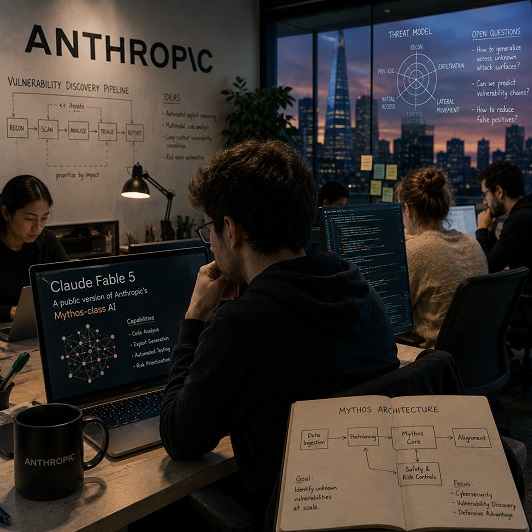
Claude Fable 5 is a public version of Anthropic’s Mythos-class AI, a highly capable model originally developed for cyber security and vulnerability discovery work.

According to Anthropic, Claude Fable 5 and Claude Mythos 5 are “the same underlying model”, with the main difference being that Fable 5 includes additional safeguards designed to prevent misuse in areas such as cyber security, biology, chemistry, and model extraction. Mythos 5, by contrast, has some of those restrictions removed for approved users.

Anthropic originally developed Mythos-class models as part of Project Glasswing, a programme aimed at helping cyber defenders and critical infrastructure providers identify serious software vulnerabilities before attackers could exploit them.

When the first Mythos model was launched in April, Anthropic limited access to a small group of carefully vetted organisations because it believed the system’s cyber capabilities presented significant risks if made widely available.

Those concerns were not entirely theoretical. According to Anthropic, organisations using Mythos-class models have already identified “more than ten thousand high- or critical-severity vulnerabilities across the most systemically important software in the world”.

Why Anthropic Decided To Release It

Anthropic says it spent several months developing safeguards that would allow Mythos-level capabilities to be released more broadly while reducing the risk of misuse.

The result was Claude Fable 5, which the company described as “a Mythos-class model that we’ve made safe for general use”.

According to Anthropic, Claude Fable 5 delivers capabilities that were previously available only to a small group of approved organisations using Mythos. The company said: “Fable 5’s capabilities exceed those of any model we’ve ever made generally available.”

The model reportedly demonstrates state-of-the-art performance across software engineering, scientific research, vision tasks, analytical reasoning, and long-running autonomous work. Anthropic said it can “work autonomously for longer than any previous Claude models”, enabling it to tackle more complex tasks with less human supervision.

To reduce the risks associated with releasing such a powerful model, Anthropic introduced new safety systems that automatically redirect certain high-risk requests to a less capable model, Claude Opus 4.8.

According to the company, those safeguards were deliberately configured conservatively because “releasing a model this capable comes with risks”.

Suspended

However, just days after launch, Anthropic announced that access to both Fable 5 and Mythos 5 was being suspended.

The company said the US government had issued an export-control directive requiring it to disable access for foreign nationals, whether inside or outside the United States. Anthropic stated that the government believed it had become aware of a method for bypassing, or “jailbreaking”, Fable 5’s safeguards. A jailbreak is a technique designed to trick an AI system into ignoring or circumventing its built-in restrictions.

Challenged By Anthropic

However, Anthropic strongly challenged the significance of the alleged vulnerability. The company said it had reviewed the reported technique and found that it was capable of identifying only “a small number of previously known, minor vulnerabilities”. It also argued that comparable results could already be achieved using other publicly available frontier AI models.

Anthropic further stated: “We disagree that the finding of a narrow potential jailbreak should be cause for recalling a commercial model deployed to hundreds of millions of people.”

The company warned that applying the same standard across the industry could effectively prevent the release of future frontier AI models.

A New Kind Of National Security Debate

The dispute highlights a broader change taking place in how governments are approaching advanced AI. For example, historically, software products were largely regulated after release if problems emerged. Frontier AI models are increasingly being treated differently because of concerns that they may create new risks in areas such as cyber security, biotechnology, critical infrastructure, defence, and intelligence.

Anthropic itself appears to recognise that reality, and the company has repeatedly argued that governments should have the ability to intervene when genuinely dangerous models emerge. However, it also insists that such decisions should be transparent and supported by clear technical evidence.

In its response to the suspension order, Anthropic stated that governments should be able to block unsafe deployments “as part of a statutory process that is transparent, fair, clear, and grounded in technical facts”.

The disagreement therefore appears to be less about whether oversight is needed and more about where the threshold for intervention should sit.

Why This Matters

The release and subsequent suspension of Fable 5 suggests that AI developers are now reaching capability levels where some models may be viewed as strategic assets rather than ordinary software products.

That raises some difficult questions for regulators, governments, technology companies, and investors alike. If advanced AI models can genuinely accelerate vulnerability discovery, scientific research, software development, and other high-value activities, restricting access could slow innovation. However, if those same capabilities can be misused, governments may feel increasing pressure to intervene.

Anthropic appears to believe that tension will become increasingly common as frontier AI systems become more capable. The company has argued that governments should have powers to intervene where genuine risks exist, while also warning that overly broad restrictions could hinder beneficial uses of the technology.

The dispute over Fable 5 therefore highlights a growing challenge facing policymakers: deciding when an AI model should be treated as a normal commercial product and when it should be treated as a potential national security concern.

What Does This Mean For Your Business?

For businesses, the story highlights how rapidly the AI landscape is evolving beyond questions of productivity and automation.

Many organisations are still deciding which AI tools to adopt, yet policymakers are already debating whether some frontier models should be treated as potential national security concerns. That represents a notable change in how AI is viewed by governments.

The wider lesson is that future AI adoption may be influenced not only by technological progress but also by regulation, export controls, safety requirements, and geopolitical considerations. As AI systems become more capable, businesses may find that access to certain models, features, or services depends as much on policy decisions as on technical innovation.

The dispute over Fable 5 may ultimately be remembered as an early example of a much larger challenge: how to make increasingly powerful AI systems broadly available while still managing the risks that come with them.

Security Stop-Press : AI Fraud Hits Insurance Claims

Aviva says fraudsters are increasingly using AI-generated evidence to support fake or exaggerated insurance claims, particularly in motor insurance.

The insurer says it detected more than 18,400 fraudulent claims during 2025, worth an estimated £233 million if paid out.

According to Aviva, fraudsters are using altered accident photos, fabricated documents, inflated repair costs, and exaggerated damage reports. The value of fraudulent motor claims rose by 39 per cent during the year.

Pete Ward, head of claims counter fraud at Aviva, said: “We’re seeing fraud become more sophisticated, from exaggerated claims to the use of AI-generated documents.”

Businesses should be aware that AI can now create highly convincing fake images and documents, making independent verification of evidence increasingly important when assessing claims, transactions, or other high-value requests.

Sustainability-in-Tech : Can Light Make AI More Sustainable?

A UK startup claims it can reduce the power consumed by AI data centre networks by 81 per cent by replacing conventional electronic switching equipment with technology that routes data using light.

Why AI’s Energy Problem Is Growing

The rapid growth of artificial intelligence is creating a major sustainability challenge. As AI models become larger and more widely used, the data centres that power them are consuming increasing amounts of electricity. Industry forecasts suggest global data centre energy demand could rise significantly over the coming decade, driven largely by AI training and inference workloads.

Much of the attention has focused on the energy consumed by powerful processors such as GPUs. However, another important source of energy consumption sits in the networks that connect those processors together.

Modern AI systems rely on thousands of chips constantly exchanging data. Every time information moves through conventional networking equipment, energy is consumed and heat is generated. As AI clusters grow larger, those networking systems are becoming increasingly expensive to power and cool.

That has prompted researchers and technology companies to look for ways of making AI infrastructure more efficient.

What Oriole Networks Has Developed

London-based startup Oriole Networks believes it has found one possible solution.

The company has developed a networking platform called PRISM that replaces traditional electronic switches in data centre networks with optical circuits that route information as photons rather than electrical signals.

For decades, data centre networks have depended on electrical switching technology. While highly effective, these systems consume significant amounts of energy and generate large quantities of heat.

Oriole argues that by allowing data to travel directly as light, much of that inefficiency can be removed.

According to the company, PRISM “removes the need for electronic switches entirely” within the network core and replaces them with “nanosecond-switched optical circuits”.

The company claims this can reduce core network power consumption by 81 per cent. It also says GPU idle time can fall from around 60 per cent to less than 1 per cent because processors spend less time waiting for information to move through the network.

Why Energy Savings Matter

The sustainability implications extend beyond electricity consumption alone. For example, networking equipment generates heat, and removing that heat requires cooling systems. Cooling can account for a substantial proportion of overall data centre energy consumption and often involves significant water usage as well.

Reducing the amount of heat produced inside a facility can therefore create multiple environmental benefits simultaneously.

Oriole argues that its technology could help reduce cooling requirements while making better use of existing AI hardware. Rather than building more data centres or adding more processors to achieve higher performance, operators may be able to extract more useful work from the infrastructure they already have.

The company also believes its approach could reduce dependence on some of the complex supply chains associated with today’s networking equipment.

Moving Into Real-World Testing

The technology is now moving beyond the laboratory. Oriole has announced that its system will be deployed as part of the UK’s £50 million ARIA Scaling Inference Lab, a government-backed initiative designed to address performance and efficiency bottlenecks in large-scale AI infrastructure.

The deployment combines Oriole’s networking technology with AMD Instinct GPUs and AMD EPYC processors.

Madhu Rangarajan, corporate vice president of Compute and Enterprise AI at AMD, described the technology as “a fundamentally different way to connect accelerators at scale” and said the collaboration is helping validate how photonic networking can provide the connectivity needed for AI inference workloads.

For Oriole, the deployment represents a significant milestone. Chief executive James Regan said: “A year ago, we were proving the physics; today, we’re proving the business.” He added that the project demonstrates how “photonic networking stops being a research curiosity and starts being the foundation of how serious AI infrastructure gets built.”

The Important Caveat

The headline figures remain company claims rather than independently verified industry benchmarks.

The ARIA deployment will provide the first large-scale commercial test of whether the technology can deliver the same benefits under real-world conditions that it has demonstrated during development.

That distinction matters because many promising hardware technologies perform well in controlled environments but struggle when deployed at the enormous scale used by major cloud and AI providers.

The wider rollout planned for 2027 will provide a clearer indication of whether photonic networking can become a practical alternative to conventional data centre infrastructure.

What Does This Mean For Your Organisation?

For organisations concerned about the environmental impact of AI, the story highlights the increasingly important reality that making AI more sustainable is not simply about building better processors.

Attention is increasingly turning towards the wider infrastructure that supports AI, including networking, cooling, power delivery, and resource utilisation.

If technologies such as Oriole’s can genuinely reduce network power consumption while improving hardware efficiency, they could help address some of the environmental pressures associated with AI’s rapid growth. Lower electricity demand, reduced cooling requirements, and better utilisation of existing hardware would all contribute towards more sustainable AI infrastructure.

Whether Oriole’s specific approach succeeds remains to be seen. However, the broader message is clear. As AI energy consumption continues to grow, innovations that reduce waste inside data centres may become just as important as advances in the AI models themselves.

Tech Tip : Use A Separate Windows Desktop For Presentations

One of the easiest ways to avoid accidentally revealing emails, Teams chats, confidential documents, browser tabs, or other sensitive information during a presentation is to create a separate desktop in Windows just for screen sharing. Here’s how to do it.

Why It Works

Windows includes a built-in Virtual Desktop feature that lets you create multiple separate workspaces on the same PC.

Instead of sharing your normal desktop, where emails, notifications, and work files may be visible, you can create a clean desktop containing only the applications you want your audience to see.

This is particularly useful for Teams meetings, Zoom calls, webinars, training sessions, customer demonstrations, and presentations.

How To Create A Presentation Desktop

Press:

Windows + Tab

Click:

New Desktop

A new, empty desktop will be created.

Open your presentation, browser window, application, or demonstration materials on this new desktop.

You can switch between desktops at any time using:

Windows + Ctrl + Left Arrow

or

Windows + Ctrl + Right Arrow

Why This Matters

Accidentally exposing confidential information during screen sharing is surprisingly common. A separate presentation desktop creates a cleaner, more professional environment and reduces the risk of unintentionally revealing emails, Teams messages, customer information, internal documents, or other sensitive business data.

It only takes a few seconds to set up and can help prevent an embarrassing and potentially costly mistake.

UK Publishers Can Opt-Out Of Google AI Search Results

The UK has become the first country in the world to require Google to let publishers opt out of AI-generated search results without sacrificing their visibility in traditional search rankings.

A New Rule For AI Search

The change follows intervention by the Competition and Markets Authority (CMA), which has imposed a new conduct requirement on Google under the UK’s Digital Markets regime.

The regulator says the move is designed to give publishers greater control over how their content is used within Google’s increasingly AI-driven search experience, while also improving transparency for users.

In practical terms, publishers will be able to prevent their content from appearing in AI-generated search features such as AI Overviews and AI Mode while remaining fully indexed and ranked within conventional Google Search results.

The CMA describes this as a “world-first” requirement and says it will help secure “a fairer deal for publishers and consumers” as AI becomes more deeply embedded within search services.

Why Publishers Have Been Concerned

The dispute centres on a growing tension between AI search systems and the websites that provide much of the information they rely on.

For decades, publishers have accepted that Google could index their content because search results generally sent visitors back to their websites. However, AI-generated summaries increasingly answer users’ questions directly on the search page, reducing the need for people to click through to the original source.

Many publishers argue that this allows AI systems to benefit from their content while reducing the traffic that helps fund journalism, research, reviews, and other forms of online publishing.

Recognising those concerns, the CMA says publishers will now have “effective tools to prevent their content being used to power AI features in search, such as AI Overviews”. The regulator believes this will place publishers “in a stronger position to negotiate content deals with Google”.

The move also extends beyond search summaries. Following consultation feedback, Google will be required to allow publishers to opt out of having their content used for the “fine-tuning” of AI models, giving them greater control over how their material is used across a wider range of AI applications.

How Google’s New Controls Will Work

Google has already begun testing the new controls with a subset of UK website owners and plans to roll them out globally.

According to the Google blog, website owners will gain access to “a new control that lets website owners manage how their links and content appear in generative AI Search features”.

The company says website owners will be able to decide “if they want their site to appear in and help ground responses in our generative AI Search features”.

Importantly, Google has confirmed that publishers who choose to opt out will not be penalised in traditional search rankings. As the company explains, “This control will not be used as a ranking signal for search results outside of these generative AI Search features.”

That distinction is crucial because many publishers have previously argued they faced an impossible choice between allowing AI systems to use their content or disappearing from Google’s search ecosystem altogether.

The controls will also be accompanied by new reporting tools within Google Search Console, giving website owners greater visibility into how their content appears within AI-generated search experiences.

A Bigger Change In Search

The announcement comes at a time when Google is rapidly transforming how search works.

Google says AI Overviews now reaches more than 2.5 billion monthly users, while AI Mode has surpassed one billion monthly users. The company argues that people are increasingly turning to generative AI tools to help them “find, sort through and understand information”.

Google also maintains that AI search creates new opportunities for publishers rather than simply diverting traffic away from them. The company says AI features are designed “to help people find and visit great websites” while helping publishers “strengthen their audiences”.

To support that goal, Google says it has increased the number of links appearing inside AI-generated responses and is continuing to experiment with new ways of encouraging users to visit source websites.

However, the CMA clearly believes safeguards are needed as these systems evolve. For example, CMA Chief Executive Sarah Cardell said: “With features like AI Overviews rapidly reshaping online search, it is crucial that content publishers, including news organisations, have appropriate bargaining power over how their content is used.”

The regulator has also required Google to improve attribution, ensuring publisher content is accompanied by clear links when it appears inside AI-generated search responses.

What Does This Mean For Your Business?

For businesses, the decision highlights how quickly AI is changing the economics of online visibility.

Whether organisations publish news, research, product information, professional advice, or marketing content, the way that material is discovered online is evolving rapidly as AI-generated answers become more common.

The CMA’s intervention suggests regulators are increasingly concerned about ensuring a fair exchange of value between AI platforms and the organisations that create the content those platforms rely upon.

The wider significance extends beyond publishers alone. As AI systems become more deeply integrated into search, businesses will need to think carefully about how their content is being used, where their traffic comes from, and how they maintain visibility in a world where users increasingly receive answers without leaving the search page.

Google’s new controls may not resolve every debate around AI and content ownership, but they do represent one of the first major attempts anywhere in the world to give content creators more control over how their material is used within AI-powered search systems.

Microsoft Unveils 1,000 Times More Reliable Quantum Chip

Microsoft has unveiled Majorana 2, a next-generation quantum chip that it says is 1,000 times more reliable than its predecessor, helping bring forward its target for a scalable quantum computer from 2033 to 2029.

What Is It?

Majorana 2 is Microsoft’s latest topological quantum chip, a processor designed to overcome one of the biggest obstacles in quantum computing, which is keeping quantum bits, or qubits, stable long enough to perform useful calculations.

According to Microsoft, the new chip is 1,000 times more reliable than its previous generation. The company says its qubits have a mean lifetime of 20 seconds, with some lasting as long as one minute. By comparison, many competing quantum systems measure qubit lifetimes in microseconds.

Microsoft attributes much of the improvement to a new materials design that replaces aluminium with lead in its topological superconductor architecture. The company says this provides greater protection against the environmental disturbances that can cause qubits to lose their quantum state and fail.

As Microsoft Technical Fellow Chetan Nayak explains, “Majorana 2 contains qubits that are 1,000x more reliable than those in our previous quantum processing unit”, and that “The new material stack, which swaps aluminium for lead, creates highly reliable topological qubits with operations on the microsecond scale and lifetimes with a mean of 20 seconds, occasionally exceeding one minute.”

Why This Matters

Reliability is one of the most important challenges facing quantum computing because even extremely powerful quantum systems are of limited value if their qubits cannot remain stable long enough to complete calculations.

Microsoft believes the improvement delivered by Majorana 2 is significant enough to accelerate its roadmap towards a scalable quantum computer. The company has now brought forward its target date from 2033 to 2029.

Microsoft’s announcement about the new quantum chip is also notable because the company says AI played an important role in achieving the breakthrough. For example, using its Microsoft Discovery platform, the company says it deployed AI agents to analyse research data, automate measurements, optimise manufacturing processes, identify hidden problems, and help researchers evaluate new materials more quickly.

Although practical large-scale quantum computing remains a major engineering challenge, Microsoft’s announcement suggests that advances in AI may now be helping accelerate progress towards systems capable of solving problems that remain beyond the reach of today’s conventional computers.

Why AI Is Part Of The Story

Although the quantum hardware itself is attracting most of the attention, Microsoft is also keen to place equal emphasis on the role of its Microsoft Discovery platform.

Microsoft Discovery uses teams of AI agents to help researchers analyse data, generate hypotheses, automate experiments, optimise manufacturing processes, and identify problems that may otherwise be missed.

According to Microsoft, AI agents were used to analyse almost two decades of quantum research data, automate complex measurement processes, optimise fabrication techniques, and even identify an uncalibrated temperature sensor that was introducing unwanted noise into the manufacturing process.

Describing the impact, Nayak said: “Agentic AI has permeated almost everything we do – it’s just become kind of a very natural part of our workflow.”

The company’s quantum team also used AI to help identify promising material combinations before conducting physical experiments, reducing the amount of costly trial-and-error testing required.

Zulfi Alam, Corporate Vice President for Quantum at Microsoft, described this as a move from the “old world order” of repeated experimentation towards simulations that identify “where the highly probable target is.”

A Different Approach To Quantum Computing

Microsoft’s strategy here seems to differ from many of its competitors. For example, companies such as IBM and Google largely focus on superconducting qubits, while Microsoft’s topological approach attempts to create a more stable form of quantum computing by exploiting exotic quantum states known as Majorana Zero Modes.

That said, the approach has not been without controversy. Microsoft’s earlier claims regarding Majorana particles attracted significant scientific scrutiny, and some previous findings were challenged by other researchers.

However, the company believes Majorana 2 demonstrates that the underlying approach is now delivering measurable engineering progress.

Support

It seems Microsoft has also attracted support from DARPA, the US Defence Advanced Research Projects Agency. DARPA has advanced Microsoft into the final phase of its Quantum Benchmarking Initiative, one of only two companies to reach that stage.

According to Microsoft, DARPA concluded that the company could “plausibly build a utility-scale quantum computer in a reasonable timeframe.”

What Could Quantum Computers Actually Do?

If Microsoft can achieve its 2029 target, the implications could be substantial. Quantum computers are not expected to replace conventional computers. Instead, they are designed to tackle highly specialised problems that are currently impractical or impossible for classical systems.

Potential applications include drug discovery, advanced materials research, energy optimisation, logistics, manufacturing, climate modelling, and cryptography.

Microsoft says a scalable quantum computer could help solve problems affecting “global health, food supply, sustainability, energy production and more.”

However, significant technical challenges remain before these systems become commercially useful at scale.

The wider quantum computing industry has a long history of optimistic forecasts, many of which have taken far longer to materialise than originally predicted.

What Does This Mean For Your Business?

For businesses, the announcement is less about purchasing quantum computers any time soon and more about understanding where things seem to be going in the world of advanced computing.

The most significant aspect of Microsoft’s announcement may actually be the growing convergence between AI and scientific research. Rather than simply helping users write documents or answer questions, AI is increasingly being used to accelerate materials science, engineering, pharmaceutical research, manufacturing, and frontier technology development.

Microsoft’s claim that AI helped reduce its quantum computing timeline by four years highlights how AI is becoming a tool for discovery as well as productivity.

Whether Microsoft’s 2029 target ultimately proves achievable remains to be seen. However, the combination of increasingly capable AI systems and advancing quantum hardware suggests that some of the world’s most difficult scientific and engineering challenges may begin moving faster than many experts previously expected.

For organisations watching emerging technologies, the bigger story may not be quantum computing alone, but how AI is increasingly being used to accelerate the creation of the next generation of technology itself.

Poland’s Tech Sovereignty Test For Government AI Purchases

Poland will introduce a new “sovereignty test” for major government technology purchases as Prime Minister Donald Tusk warns that growing dependence on foreign digital infrastructure and AI providers has become a strategic national concern.

What Has Been Announced?

Speaking at the European Financial Congress in Sopot, Tusk said Poland would begin assessing significant public-sector technology procurements through a sovereignty lens, while also publishing annual reports tracking the country’s progress towards greater IT independence.

Although the full details of the test have not yet been released, the policy is expected to examine issues such as vendor dependence, control over critical systems, access to data, and the strategic risks associated with relying heavily on a small number of technology suppliers.

Explaining the reasoning behind the move, Tusk said: “At this point, the scale of this dependency, and I’m referring here to the relationship between the state and the digital sphere, has reached such proportions that it must prompt serious economic, institutional, and organisational decisions.”

The announcement represents one of the clearest examples yet of a European government moving beyond discussions about digital sovereignty and beginning to embed those concerns directly into procurement policy.

Why Poland Is Concerned

The policy reflects growing concern across Europe that critical public services increasingly depend on technology platforms, cloud infrastructure, AI systems, and digital services controlled by a relatively small number of foreign companies.

Tusk argued that technological sovereignty should become a strategic objective for Poland, not because the country wants to isolate itself from global technology markets, but because governments need meaningful choice rather than dependence.

According to figures cited by the Polish government, the country’s digital trade deficit has grown from approximately PLN 9 billion in 2016 to around PLN 45 billion in 2025, highlighting the increasing flow of technology spending towards foreign providers.

At the same time, artificial intelligence is creating new forms of dependency. Governments increasingly rely on cloud platforms, AI models, cybersecurity tools, data infrastructure, and software ecosystems that are often developed and controlled outside their own borders.

As AI becomes embedded in healthcare, public administration, education, defence, transport, and critical infrastructure, questions about who owns, controls, and maintains those systems are becoming more politically significant.

Part Of A Wider European Debate

Poland’s announcement reflects a wider debate taking place across Europe about digital sovereignty. For example, for several years, European policymakers have expressed concerns about dependence on both American technology giants and Chinese hardware suppliers. However, the rapid emergence of generative AI has added fresh urgency to those discussions.

Many European leaders now worry that regulation alone may not be enough if the most advanced AI systems, cloud platforms, and digital infrastructure remain concentrated in the hands of a small number of overseas providers.

The challenge is particularly evident in AI, where the most advanced models currently come largely from companies based in the United States. European governments and businesses increasingly face difficult decisions about balancing access to the best available technology against concerns around strategic dependence.

Poland has already taken steps in this direction. For example, earlier this year, the government restricted certain Chinese technologies from sensitive military environments and has increased support for domestic AI initiatives, including the development of Polish-language AI models.

What Could The Sovereignty Test Mean In Practice?

Although the final framework remains unclear, the test is unlikely to operate as a simple ban on foreign technology suppliers.

Instead, it appears more likely that government departments will be required to assess whether major procurements create excessive dependence on a single vendor or introduce risks around control, resilience, security, or long-term flexibility.

For example, authorities may need to consider whether critical systems can be migrated elsewhere if required, whether data remains under appropriate control, and whether alternative suppliers exist.

Such considerations are already becoming common in discussions around cloud computing, cybersecurity platforms, AI systems, telecommunications infrastructure, and public-sector software procurement.

The broader objective appears to be ensuring that Poland retains meaningful strategic choice rather than finding itself locked into technologies that become difficult or impossible to replace.

What Does This Mean For Your Business?

For businesses, Poland’s announcement highlights how technology procurement is increasingly becoming a strategic and geopolitical issue rather than simply a commercial one.

Cost, functionality, and performance remain important, but governments and organisations are paying growing attention to questions of control, resilience, supplier concentration, and long-term dependency.

The policy also reflects a wider change in how AI is being viewed. Rather than treating AI purely as a productivity tool, governments are increasingly seeing access to AI infrastructure and capabilities as a matter of economic competitiveness and national security.

Whether other countries follow Poland’s lead remains to be seen. However, the introduction of a sovereignty test suggests that future technology purchasing decisions may increasingly involve questions about who controls the technology, where it is hosted, and how dependent organisations become on the companies that provide it.