All posts by Paul Stradling

Company Check : Adobe Agrees $150 Million Settlement Over Subscription Practices

Adobe has agreed to a $150 million settlement with US regulators over allegations that it hid key subscription terms and made cancellations unnecessarily difficult, bringing renewed attention to how subscription-based services are designed and enforced.

What The Case Was About

The case, brought by the US Department of Justice (DOJ) and the Federal Trade Commission (FTC), focused on Adobe’s “annual paid monthly” subscription plan, widely used across products such as Photoshop and Acrobat.

Regulators alleged that Adobe failed to clearly disclose early termination fees, which could reach hundreds of dollars, and placed this information in fine print or behind hyperlinks that many users would not reasonably see.

The complaint also claimed that cancelling a subscription was overly complex. Customers attempting to cancel online were reportedly required to navigate multiple pages, while those cancelling by phone faced delays, repeated explanations, and resistance.

In simple terms, the government argued that customers were not being given a clear, informed choice at sign-up, and were then discouraged from leaving.

Understanding ROSCA In Plain English

At the centre of the case is the Restore Online Shoppers’ Confidence Act (ROSCA), a US law introduced in 2010.

ROSCA requires businesses offering online subscriptions to do three basic things, which are to clearly explain all important terms before charging customers, obtain explicit informed consent before billing, and provide a straightforward way to cancel.

The law was designed to prevent so-called “dark patterns”, where companies use design techniques to push users into decisions they might not otherwise make.

In this case, regulators argued that Adobe’s processes fell short on all three counts.

What The Settlement Includes

The proposed settlement, which still requires court approval, includes both financial and operational measures.

Adobe will pay a $75 million civil penalty and provide $75 million worth of free services to affected customers. It must also introduce clearer disclosures around early termination fees, improve cancellation processes, and provide reminders before free trials convert into paid subscriptions where fees may apply.

The agreement also resolves claims against two senior Adobe executives named in the original complaint.

Regulator Response

US officials framed the case as part of a broader effort to tackle deceptive subscription practices across digital services.

“American consumers deserve the right to make informed choices when deciding where to spend their hard-earned money,” said Assistant Attorney General Brett A. Shumate, head of the Justice Department’s Civil Division. “The Justice Department will strongly oppose any attempt to harm Americans with deceptive and unfair business practices.”

“Consumers should not have to navigate a digital maze to cancel a subscription,” said U.S. Attorney Craig H. Missakian for the Northern District of California. “We will continue to hold responsible any company that uses deceptive business practices to harm the consumer.”

These statements underline a clear regulatory direction that subscription models must be built around transparency and user control.

Adobe’s Response

Adobe has denied wrongdoing while agreeing to settle the case.

In a statement, the company said it had already streamlined its subscription sign-up and cancellation processes and made them more transparent in recent years, adding that it was “pleased to resolve this matter”.

Adobe has also maintained that its subscription services are designed to be flexible and cost-effective, allowing users to choose plans that suit their needs, timeline and budget.

The decision to settle appears to be a practical step to close the case rather than an admission of liability.

Why This Matters Now

This case comes at a time when subscription-based models dominate much of the software industry.

Adobe itself generates the vast majority of its revenue from subscriptions, a model it helped to popularise. At the same time, regulators are increasing scrutiny of how these models are implemented, particularly where customer choice may be constrained.

There is also wider pressure on Adobe, including growing competition from AI-driven tools and uncertainty following the announced departure of its long-standing CEO.

The result is a situation where both regulatory and market pressures are converging on how digital services are delivered.

What Does This Mean For Your Business?

For UK businesses, even though ROSCA is a US law, the underlying expectations closely mirror UK consumer protection principles and CMA guidance around fairness and transparency.

Clear, upfront disclosure is becoming non-negotiable. Key terms such as pricing, renewal conditions, and cancellation fees need to be visible at the point of purchase, not hidden in links or lengthy terms and conditions that users are unlikely to read in full.

Cancellation processes are also under growing scrutiny. If a customer can sign up quickly online, they should be able to cancel just as easily. Any unnecessary friction, delays or forced interactions may now be viewed as a compliance risk rather than a commercial tactic.

There is also a broader design implication. Subscription journeys, user interfaces, and account settings are no longer just product decisions. They are part of regulatory compliance, with enforcement bodies increasingly examining how digital experiences influence user behaviour.

Customer expectations are changing as well. Users are more aware of their rights and less tolerant of being locked into services they no longer want, which means poor subscription design can quickly become a reputational issue.

For MSPs, SaaS providers and any business using recurring billing, this case is a clear signal. Transparent pricing, simple processes and easy exits are becoming the standard. Businesses that align with these expectations are more likely to build trust and retain customers, while those that do not risk both regulatory action and customer dissatisfaction.


Security Stop-Press : Automating Penetration Testing With AI Agents

Escape has raised $18 million to develop AI agents that automate penetration testing and help security teams keep pace with faster cyber threats.

Its platform simulates attacker behaviour in live systems, identifying vulnerabilities, proving how they can be exploited, and recommending fixes, replacing periodic manual testing with continuous coverage.

The move follows research that found over 2,000 high-impact vulnerabilities across 5,600 AI-built applications, including exposed secrets and personal data in live environments.

For businesses, the risk is clear. Occasional testing is no longer enough, and organisations should adopt continuous security monitoring and ensure vulnerabilities are identified and fixed quickly before they are exploited.

Sustainability-in-Tech : Why Measuring Plasma Could Unlock Fusion Power

A new report suggests that the future of fusion energy may depend less on generating power, and more on measuring it accurately.

Understanding The Real Barrier To Fusion

Fusion power has long been seen as a near-perfect clean energy source, offering abundant electricity with minimal environmental impact. The science behind it is well understood, involving the fusion of atomic nuclei at extremely high temperatures to release energy. However, turning this into a reliable, commercial power source has remained out of reach, largely due to the difficulty of controlling the process in real time.

At the centre of this challenge is plasma, a superheated state of matter that must be carefully managed inside a fusion reactor. For fusion to occur consistently, scientists need to monitor conditions such as temperature, density, and stability with extreme precision. Even small fluctuations can disrupt the reaction and bring it to a halt.

Why Measurement Technology Is Now Critical

A growing body of research, including a recent U.S. Department of Energy-backed report, highlights that advances in diagnostic technology could play a decisive role in making fusion commercially viable. Diagnostics are specialised systems used to measure and observe plasma behaviour inside a reactor while it is operating.

The report suggests that the ability to measure, understand, and control plasma under extreme conditions is now one of the most important factors in accelerating progress towards working fusion power plants. As the report states, “Diagnostics will be critical to determining whether the U.S. can sustain a burning plasma, engineer for extreme environments, and translate plasma science into deployable systems.”

The Engineering Challenge Inside Fusion Reactors

The conditions inside a fusion reactor are among the most extreme ever created by humans. Sensors must operate in environments with intense heat, high radiation, and very limited physical access. Conventional measurement tools are simply not designed to survive these conditions.

As a result, researchers are focusing on developing radiation-resistant sensors, faster measurement systems, and more robust designs that can continue to function reliably over time. In some fusion approaches, particularly inertial confinement, key events happen in fractions of a second, meaning diagnostics must capture data at extremely high speeds.

Without these capabilities, it becomes almost impossible to maintain the precise conditions required for sustained fusion reactions.

The Growing Role Of AI And Digital Twins

Alongside physical measurement tools, software is becoming equally important. Fusion experiments generate vast amounts of complex data that cannot be easily interpreted in real time by human operators alone.

Artificial intelligence and machine learning are now being used to analyse this data, detect patterns, and predict instabilities before they occur. This allows researchers to make faster adjustments and maintain stable plasma conditions for longer periods. As highlighted in the report, this includes “AI-enhanced data interpretation and integrated data analysis” as well as “digital twins that unite simulation and experiment.”

Digital twins are also emerging as a key tool. These are virtual models of fusion systems that combine simulation with real-world data. They allow scientists to test different scenarios, optimise performance, and refine control strategies without putting physical systems at risk. Over time, this approach could reduce development costs and accelerate progress towards commercial deployment.

A Decisive Decade For Fusion Development

Fusion energy is now entering what many researchers describe as a decisive period. Pilot plants are being targeted for the 2030s and 2040s, and global competition is increasing across both public and private sectors.

The report makes this urgency clear, noting that “the speed of progress across fusion and plasma tech now hinges on our ability to innovate.” Major programmes such as ITER in France and the UK’s STEP initiative are placing increasing emphasis on measurement and control technologies, while private fusion companies are investing heavily in the same areas.

This actually reflects a broader shift in focus. For example, earlier efforts were centred on demonstrating that fusion reactions could be achieved. That milestone has largely been reached in controlled experiments. The next stage is engineering systems that can operate continuously and reliably at scale.

The Sustainability Case For Fusion

The long-term appeal of fusion remains strong. It offers the potential for large-scale, low-carbon electricity generation without the long-lived radioactive waste associated with traditional nuclear power. It also relies on widely available fuels, which could reduce dependence on fossil fuels and improve energy security.

However, these benefits depend on overcoming the remaining technical barriers. Measurement and control are now seen as central to that challenge, making them a critical focus for investment and innovation.

What Does This Mean For Your Business?

Fusion power itself may still be years away from commercial use, but the technologies being developed to enable it are already starting to influence other industries. Advanced sensing systems, real-time data analysis, AI-driven decision-making, and digital twin modelling are not unique to fusion. They are increasingly being adopted in sectors such as manufacturing, energy, infrastructure, and logistics.

For UK businesses, this highlights an important point. The value of these innovations does not depend on fusion becoming mainstream in the near term. The underlying capabilities are already delivering practical benefits today, particularly in environments where performance, efficiency, and reliability depend on accurate measurement and fast decision-making.

There is also a clear strategic angle here. As energy systems evolve, businesses that rely heavily on power, including data centres, manufacturing sites, and large commercial facilities, will need to adapt to new energy sources and more dynamic grid conditions. Understanding how technologies like AI-driven monitoring and predictive control work could become increasingly important in managing costs and resilience.

At the same time, this research reinforces a broader lesson about innovation. Breakthroughs often depend not just on headline technologies, but on the supporting systems that make them usable at scale. In the case of fusion, the ability to measure and control plasma may prove to be just as important as the reaction itself.

Organisations that recognise the importance of these enabling technologies, and begin exploring how similar approaches can be applied within their own operations, may be better positioned to improve efficiency, reduce risk, and take advantage of future developments as they emerge.

Video Update : GPT 5.4 Launched – Here’s Why You Should Use It

OpenAI’s new GPT 5.4 model introduces more accurate responses, better reasoning and improved real world usefulness, and this video shows why it is worth using to get faster, more reliable results from your everyday AI prompts.

[Note – To Watch This Video without glitches/interruptions, It may be best to download it first]

Tech Tip : Adjust Your Spam Filter Settings To Avoid Missing Important Emails

Spam filters can sometimes misclassify legitimate emails, so regularly reviewing your junk folder and adjusting settings is a simple way to avoid missing important enquiries, invoices or client messages.

Why This Matters

Email filtering has become more aggressive in recent years as providers try to block phishing, spam and malicious attachments.

While this improves security, it also increases the chances of genuine emails being incorrectly flagged as junk.

This can include:

– New customer enquiries

– Supplier invoices

– Automated system alerts

– Replies from new contacts

If these emails are missed, it can lead to delayed responses, missed opportunities or unnecessary disruption to business operations.

How To Adjust Junk Email Settings In Microsoft Outlook (Microsoft 365)

– Open Outlook (desktop app or web).

– Go to the Junk Email folder.

– Review recent messages.

– Right-click any legitimate email.

– Select Not junk.

To prevent this happening again:

– Add the sender to your Safe senders list.

– Or add the domain (e.g. @companyname.co.uk) to trusted senders.

How To Adjust Spam Settings In Gmail (Google Workspace)

– Open Gmail.

– Click the Spam folder in the left-hand menu.

– Review recent messages.

– Open any legitimate email.

– Click Report not spam.

You can also:

– Add the sender to your Contacts.

– Create a filter to always allow emails from specific addresses or domains.

What To Watch For

If legitimate emails are regularly going to spam, check:

– Whether the sender is new or unknown.

– If their domain has poor email reputation.

– Whether your organisation has strict filtering policies enabled.

In some cases, your IT provider may need to review mail filtering settings.

A Practical Approach

A quick check and small adjustment can prevent important emails being missed.

Spending a minute reviewing your spam settings each week helps ensure genuine messages reach your inbox and reduces the risk of missed opportunities or delayed responses.

Tesla Wins Licence To Supply Electricity In Britain

Tesla has been granted a licence to supply electricity directly to homes and businesses in Britain, marking a significant step in the company’s effort to expand from electric vehicles into a full energy provider.

Tesla Receives Approval To Supply Electricity

Tesla subsidiary Tesla Energy Ventures has reportedly (according to reports by The Wall Street Journal) received approval from the UK energy regulator Ofgem to supply electricity to domestic and commercial customers across England, Scotland and Wales.

The licence allows Tesla to sell electricity directly to households and businesses in much the same way as established suppliers such as British Gas, EDF, E.ON and Octopus Energy. Northern Ireland is not included, as it operates under a separate electricity market.

Ofgem confirmed that the application underwent a full regulatory review between July 2025 and March 2026. The regulator assessed whether Tesla could meet the financial, operational and consumer protection standards required of all electricity suppliers in Britain.

As with any licensed supplier, Tesla must now comply with the UK’s strict energy market rules covering billing transparency, customer treatment, financial resilience and dispute resolution.

A Long Term Strategy In The UK Energy Market

Although the licence approval is new, Tesla has actually been building its presence in the British electricity sector for several years.

The company first obtained an electricity generation licence in 2020, allowing it to operate energy assets connected to the national grid. Since then Tesla has deployed large grid scale battery systems across the country using its Megapack technology.

One of the most notable projects is the Pillswood battery facility near Hull, which at the time of its launch in 2022 was one of Europe’s largest battery storage systems with a capacity of 196 megawatt hours.

Tesla has also been active in energy trading through its Autobidder software platform, which uses artificial intelligence to automatically buy and sell electricity in response to market conditions.

These developments laid the groundwork for the company to move into direct electricity supply.

How Tesla’s Energy Model Works

Tesla’s entry into the UK electricity market is likely to follow a model already used in Texas through its Tesla Electric service.

The approach combines several elements of Tesla’s broader energy ecosystem. These include home solar generation, battery storage, grid scale energy storage and software driven electricity trading.

Customers with Tesla Powerwall home batteries can store electricity generated by rooftop solar panels or purchased from the grid when prices are low. The stored energy can then be used later or exported back to the grid.

When large numbers of home batteries are connected together they can form what is known as a virtual power plant. This network of distributed energy storage can help stabilise the grid during periods of high demand while also generating revenue for participants.

Tesla’s Autobidder software manages the flow of electricity between batteries, the grid and wholesale markets in real time. The system automatically adjusts when energy is bought, stored or sold.

This model allows Tesla to treat energy not simply as a commodity delivered to homes, but as a dynamic resource that can be managed through software.

Competition With Established Suppliers

Obviously, Tesla’s arrival adds a new competitor to a crowded but rapidly evolving UK energy market.

Companies such as Octopus Energy have already demonstrated how software driven platforms and flexible tariffs can disrupt traditional energy supply models. Octopus has grown rapidly by combining renewable energy sourcing with advanced pricing systems and digital customer services.

In fact, Tesla and Octopus have previously worked together in Britain through the Tesla Energy Plan, which connected Powerwall owners to Octopus electricity tariffs.

However, now that Tesla can operate as a supplier in its own right, that partnership may evolve into direct competition.

The company will also compete with large incumbent utilities including British Gas, EDF and E.ON, which together supply millions of UK households.

Public Opposition And Regulatory Scrutiny

Tesla’s application attracted some significant public criticism during the consultation process.

For example, campaign groups organised thousands of submissions to Ofgem expressing concern about Elon Musk’s political statements and online activity. Critics argued that these issues should be considered when deciding whether the company should operate in the UK energy market.

Ofgem stated that licensing decisions are based on regulatory and operational criteria rather than opinions about company leadership. The regulator concluded that Tesla’s application met the legal requirements for a supply licence.

Government officials also confirmed that Ofgem has sole responsibility for assessing such applications.

A Move Toward Software Led Energy Systems

Tesla’s move into electricity supply reflects a broader trend across global energy markets.

Electricity systems are becoming increasingly dependent on renewable energy sources such as wind and solar. These sources generate power intermittently, which creates new challenges for grid stability.

Battery storage and intelligent software systems are emerging as key tools for balancing supply and demand. Grid scale batteries can store excess energy when production is high and release it when demand rises.

Companies that combine generation, storage and software control may therefore gain a strategic advantage in the evolving energy sector.

Tesla has been positioning its energy division around precisely this combination.

What Does This Mean For Your Business?

Tesla’s entry into the UK electricity market highlights how energy supply is becoming increasingly technology driven.

Businesses may soon see new types of electricity tariffs that combine battery storage, renewable generation and software based energy optimisation. This could (hopefully) lead to more flexible pricing models and opportunities to reduce energy costs through smarter usage patterns.

Organisations with on site solar generation or battery storage may also benefit from emerging virtual power plant programmes, where surplus energy can be sold back to the grid.

The development also signals a wider transformation of the electricity sector. Traditional utilities are increasingly competing with technology companies that treat energy management as a data and software problem rather than simply a supply service.

For businesses planning long term energy strategies, the ability to integrate storage, renewable generation and intelligent energy management systems is likely to become increasingly important.

Why Some People Can Spot AI Images More Easily Than Others

New research suggests that the ability to detect AI-generated faces may depend less on intelligence or technical knowledge and more on a fundamental visual skill known as object recognition.

A Surprising Predictor Of AI Detection

As artificial intelligence tools become increasingly capable of generating realistic images, concerns about deepfakes and digital misinformation have grown rapidly. Synthetic faces created by AI systems now appear regularly across social media, advertising and online content, often looking convincingly real.

A new study from researchers at Vanderbilt University (in Nashville, Tennessee) has examined why some people are better than others at detecting these images. The findings suggest that the key factor is not intelligence, technological expertise or familiarity with AI tools, but a more basic perceptual ability.

Object Recognition

The research was led by Isabel Gauthier, professor of psychology at Vanderbilt University, together with Jason Chow and Rankin McGugin. Their study, published in the Journal of Experimental Psychology, found that individuals with stronger object recognition skills consistently performed better at identifying AI-generated faces.

Object recognition is a broad visual ability that allows people to distinguish between very similar objects quickly and accurately. In scientific research it is sometimes referred to as the “o factor”, a domain-general skill involved in recognising patterns and structures across many different visual tasks.

Testing The Ability To Detect AI Faces

To investigate how people recognise synthetic images, the researchers developed a new evaluation tool called the AI Face Test. Participants were shown a mixture of real photographs and faces generated by artificial intelligence systems and asked to determine which images were authentic.

The study then compared each participant’s performance with a range of cognitive and perceptual abilities, including intelligence, face recognition skills and familiarity with artificial intelligence technology.

The results revealed that object recognition ability is the strongest predictor of success in detecting AI-generated faces.

In contrast, factors that might seem more relevant, such as intelligence or experience with AI tools, showed little relationship with performance.

A Useful Visual Ability

As Professor Gauthier explained, “these results highlight a visual ability that has very general applications. It’s a stable trait that helps people meet new perceptual challenges, including those created by AI.”

The researchers were particularly surprised that technological experience did not appear to help participants distinguish between real and synthetic images.

“We were shocked to see how intelligence or even technology training did not help accurately judge if a face is AI,” Gauthier said.

Why Some People Are Better At Object Recognition

It seems that some people are just naturally better at this particular skill. Object recognition ability varies between individuals, but those with stronger visual processing skills are better at detecting small structural differences in images. This means that when looking at AI-generated faces, they are more likely to notice subtle inconsistencies in areas such as lighting, texture or facial proportions that others may overlook.

It’s An Underlying Perceptual Ability

In the Vanderbilt study, participants with higher object recognition scores consistently performed better at identifying AI-generated faces in the AI Face Test. Their performance also remained stable when tested again later, suggesting the skill reflects an underlying perceptual ability rather than something people quickly learn through experience with AI tools.

Looking Beyond Obvious Visual Errors

Researchers believe the advantage does not come from spotting obvious “AI mistakes”. Instead, people with stronger object recognition ability appear better at interpreting complex visual structure when the differences are subtle and the signals are noisy.

Can This Skill Be Improved?

All is not lost for those who do not naturally have this skill. There is some evidence that aspects of object recognition can be improved through training. For example, exercises that involve comparing similar objects, analysing small visual variations and practising detailed visual inspection can strengthen perceptual judgement over time.

Useful In Medical Imaging and Radiology

Research in fields such as medical imaging and radiology shows that targeted visual training can improve a person’s ability to recognise subtle visual differences. That said, people with stronger object recognition skills often perform better in visually demanding tasks, including identifying lung nodules in medical scans, recognising cancerous blood cells, reading musical notation and analysing retinal images.

A Wider Skill With Many Applications

Object recognition ability has been linked in previous research to success across a wide range of visually demanding tasks. The Vanderbilt University study takes things one step further by also challenging the widely repeated claim that AI-generated images are now impossible for humans to detect.

“There is this general message we hear in the media that AI images are so realistic that we can’t tell the difference, and I think that’s misleading,” Gauthier said.

According to the researchers, the results instead show a distribution of abilities across the population. Some people struggle to detect synthetic images, some perform moderately well and others identify them with high accuracy. Understanding these differences may become increasingly important as generative AI technologies continue to evolve.

What Does This Mean For Your Business?

For organisations concerned about misinformation, digital trust and online security, the research highlights an important point about the human side of AI detection.

Many current discussions about identifying synthetic media focus on technical solutions such as watermarking systems, detection algorithms or digital authentication tools. These technologies will likely remain important as AI-generated content becomes more widespread.

However, the new research suggests that human perception also plays a significant role. Individuals differ in their natural ability to interpret complex visual information, and this may affect how easily they recognise AI-generated imagery.

For businesses that rely on visual content, such as media organisations, marketing teams and social media platforms, understanding these differences could help shape training programmes, moderation strategies and verification processes.

As AI-generated media becomes more common across the internet, combining technical safeguards with a deeper understanding of human perception may become an increasingly important part of managing digital authenticity.

Amazon Brings AI Health Assistant To Its Website And App

Amazon has launched a new AI-powered healthcare assistant called Health AI on its website and mobile app, marking a significant step in the company’s effort to use artificial intelligence to help people understand medical information and access care more easily.

Why Amazon Is Expanding Into AI-Powered Healthcare

Amazon’s entry into AI-driven healthcare builds on several major moves the company has made in the sector over the past few years. In 2023 it acquired the primary care provider One Medical for $3.9 billion, adding a nationwide network of clinics and telehealth services to its growing health portfolio.

Alongside this, Amazon has expanded its pharmacy services and introduced digital tools designed to simplify medication management and appointment booking. Health AI now becomes a central interface within this ecosystem, allowing customers to ask health-related questions directly through the Amazon website or mobile app.

According to Amazon, the goal of Health AI is to make healthcare easier to navigate and more accessible. As the company explains on its website, the assistant is designed “to make health care easier by providing you with insights into your health, helping you understand your medical records, and seamlessly connecting you with licensed health care professionals when you need them.”

What The Amazon Health AI Assistant Actually Does

Health AI functions as a conversational assistant that can answer health questions and help users understand information about their health.

For example, users can ask questions about symptoms, medications or test results. The system can also explain medical records, provide guidance about possible next steps and help arrange professional care when needed.

In addition to answering questions, Amazon says Health AI can assist with practical tasks such as managing prescription renewals or booking appointments with healthcare providers. If a user needs medical support, the system can connect them to clinicians through Amazon One Medical.

However, Amazon is keen to point out that the tool is designed to help people better understand their health rather than replace professional medical advice.

How It Works

Health AI operates as what Amazon describes as an “agentic” AI system. This means that instead of acting only as a chatbot, the system can also take actions on behalf of the user, such as arranging appointments or managing prescriptions.

With a user’s permission, Health AI can access medical information such as diagnoses, medications and lab results through the United States Health Information Exchange. This nationwide network allows healthcare providers to share patient data securely.

Using that information, the assistant can provide more personalised responses. For example, if a user asks about a symptom, the system can consider their medical history and current medications when explaining possible causes.

When professional care is needed, the system can connect users directly to a One Medical clinician via message, video consultation or an in-person appointment.

Where?

At present, Amazon’s Health AI assistant is being rolled out only to customers in the United States. The company says availability will expand gradually across the US in the coming weeks as more users gain access through the Amazon website and mobile app.

Amazon has not yet announced when the service may become available in the UK or other international markets. Healthcare services are heavily regulated and differ significantly between countries, which means new digital health tools often launch first in the US before being adapted for other healthcare systems.

For now, the service is closely linked to Amazon One Medical and other US-based healthcare services, which makes a wider international rollout more complex.

What About Privacy And Safety?

Amazon says Health AI has been designed to meet strict privacy and security standards, reflecting the sensitive nature of the medical information the system handles.

All interactions take place within a HIPAA-compliant environment, the regulatory framework that governs the protection of medical information in the US. Conversations are encrypted and access to data is restricted to authorised personnel performing specific healthcare functions.

Amazon also says that Health AI models are trained using abstracted data patterns rather than identifiable patient information.

Warning

Despite these safeguards, privacy experts have warned that AI systems handling medical data must be monitored carefully, particularly as companies continue to improve and train their models using large volumes of user interactions. As Stanford researcher Dr Nigam Shah has noted, “AI systems in healthcare must be evaluated carefully in real-world settings because even small errors can have significant consequences for patients.”

The Rise Of AI Assistants In Healthcare

Amazon’s move reflects a wider trend in the technology sector where AI is rapidly becoming part of how healthcare services interact with patients.

For example, earlier this year OpenAI introduced a version of ChatGPT designed to answer health-related questions, while Anthropic launched its own healthcare-focused AI product.

Many technology companies believe AI assistants could help patients navigate complex healthcare systems, understand medical information and access care more quickly.

However, the expansion of these systems also raises questions about safety and reliability.

Safety Questions Surrounding Medical Chatbots

Recent research has highlighted potential risks when AI systems become involved in healthcare processes.

Security researchers at the AI safety firm Mindgard recently demonstrated that a medical chatbot used in a US telehealth pilot could be manipulated through a technique known as prompt injection. By exploiting weaknesses in the system’s internal instructions, the researchers were able to push the chatbot into generating misleading medical guidance and unsafe recommendations.

The experiment also showed that manipulated information could appear in structured medical summaries passed to clinicians as part of the consultation process.

Researchers warned that systems producing authoritative-looking medical information could influence clinical decision-making if safeguards are not robust.

Why Companies Are Still Pursuing AI Health Assistants

Despite these concerns, companies continue to invest heavily in AI tools designed to support healthcare services.

Healthcare systems in many countries are struggling with rising demand, administrative complexity and limited clinical capacity. Technology firms argue that AI assistants could help patients obtain basic guidance more quickly and reduce the burden on healthcare providers.

Amazon says Health AI is intended to support clinicians rather than replace them, helping patients understand information and navigate healthcare services more efficiently.

What Does This Mean For Your Business?

Amazon’s Health AI launch highlights how artificial intelligence is increasingly becoming a front door to complex services such as healthcare.

The move also places Amazon more directly in competition with other technology companies that are introducing healthcare-focused AI tools, including OpenAI’s health-oriented chatbot features and Anthropic’s Claude for Healthcare. As these systems improve, AI assistants could become a common way for people to seek initial medical guidance, interpret health information and navigate care services.

For businesses operating in sectors that depend on trust and accurate information, including healthcare providers, insurers, financial institutions and legal firms, the development illustrates both the opportunities and the risks of AI systems that interact directly with customers.

AI assistants may help simplify access to services and improve user experience. However, they also introduce new responsibilities around safety, transparency and oversight, particularly when systems provide advice or generate information that may influence important decisions.

As more organisations deploy AI to support customer interactions, ensuring that these systems remain reliable, secure and resistant to manipulation will become an increasingly important challenge.

ChatGPT Launches Interactive Visual Tools

OpenAI has introduced a new feature in ChatGPT that allows users to understand maths and science concepts through interactive visual explanations, turning formulas and equations into dynamic models that can be manipulated in real time.

Why?

This new capability reflects the growing role of ChatGPT as a learning tool rather than simply a conversational AI assistant. According to OpenAI, millions of people already rely on the system to help them understand academic subjects.

As the company explains, “ChatGPT has quickly become one of the most widely used tools for learning. Each week, 140 million people use ChatGPT to help them understand math and science concepts alone.”

Maths and science are areas where many learners struggle with abstract ideas and formulas that can be difficult to visualise. OpenAI says the new feature aims to make these concepts easier to understand by allowing users to interact with them directly rather than simply reading about them.

Turning Equations Into Interactive Experiments

The new feature, called dynamic visual explanations, enables ChatGPT to generate interactive visual modules when users ask questions about certain mathematical or scientific topics.

This means that, instead of receiving only a written explanation or a static diagram, users can adjust numbers and variables and immediately see how the results change. This effectively turns equations into small interactive experiments that learners can explore.

For example, someone asking about the Pythagorean theorem can adjust the lengths of the sides of a triangle and instantly see how the hypotenuse changes. A user exploring compound interest could modify the interest rate or time period and watch the growth curve update in real time.

According to OpenAI, the goal is to help people understand how relationships between variables actually work.

Examples Of What It Can Do

The interactive visuals support more than 70 maths and science topics, including concepts commonly taught at high school and college level.

Among the topics currently available are the Pythagorean theorem, Ohm’s law, Hooke’s law, exponential decay, kinetic energy, Coulomb’s law and compound interest. Geometry topics such as circle area and triangle area are also included.

When users ask ChatGPT about one of these subjects, the system can now provide both a written explanation and an interactive visual model that responds as the user adjusts variables.

OpenAI says the number of supported topics will expand over time as the system evolves.

Why Visual Learning Can Improve Understanding

The idea behind the feature is based on educational research suggesting that visual and interactive learning can improve understanding of complex subjects.

Many mathematical and scientific concepts describe relationships between variables. Seeing those relationships change dynamically can make them easier to grasp.

OpenAI explains that the goal is to move beyond simple explanations and help learners understand how ideas connect. As one educator involved in early feedback on the system noted, “What stands out is how strongly this feature emphasises conceptual understanding. When learning math, understanding why something works and how ideas connect helps concepts stick long term.”

The system has also been designed to encourage users to explore concepts further by adjusting variables and testing different scenarios.

How The Feature Fits Into ChatGPT’s Growing Education Tools

Dynamic visual explanations are actually part of a wider effort by OpenAI to develop ChatGPT as a learning platform.

In recent years, the company has introduced several features designed to support studying and exam preparation. These include Study Mode, which guides users through problems step by step, and quiz tools that allow people to create flashcards and test their knowledge.

OpenAI says the broader aim is to help people explore ideas and build deeper understanding.

As the company explains, “Helping people explore ideas, experiment with concepts, and build deeper understanding is one of the most meaningful ways we can bring the benefits of AI to people everywhere.”

The new visual tools extend that approach by allowing users to experiment directly with the mathematical relationships behind many common formulas.

AI Learning Tools Are Becoming A Competitive Battleground

OpenAI is not the only company exploring interactive learning tools powered by artificial intelligence. Other major AI developers are also introducing visual learning features. Google, for example, recently added interactive diagrams to its Gemini AI system to help explain scientific and mathematical concepts.

These developments really reflect a broader shift in how AI systems are being used in education. For example, rather than simply providing answers to questions, they are increasingly designed to act as interactive learning environments.

At the same time, the growing use of AI in education has sparked debate among teachers and policymakers. Some educators worry that students may become too dependent on AI tools, while others see them as a valuable way to support understanding of difficult subjects.

What Does This Mean For Your Business?

The introduction of interactive learning features in ChatGPT highlights how AI systems are evolving from information tools into platforms that help people understand complex ideas more effectively.

For businesses, this development may have implications for training, professional development and workplace learning. Many organisations already rely on digital tools to help employees develop technical skills in areas such as engineering, finance, data analysis and IT.

Interactive AI systems could make it easier for staff to understand complex concepts by allowing them to manipulate variables and see how formulas and scientific relationships behave in real time, rather than simply reading static explanations.

For organisations responsible for technical training, this could help accelerate learning and make difficult subjects more accessible to employees who may not have strong mathematical or scientific backgrounds.

At the same time, the growing role of AI in learning environments means businesses will need to think carefully about how these tools are used alongside traditional teaching, mentoring and professional guidance.

As AI learning tools continue to develop, they may increasingly become part of how organisations train staff in technical subjects such as mathematics, science, engineering and financial modelling.

Company Check : Microsoft Introduces Copilot Cowork For Agentic AI-Driven Work

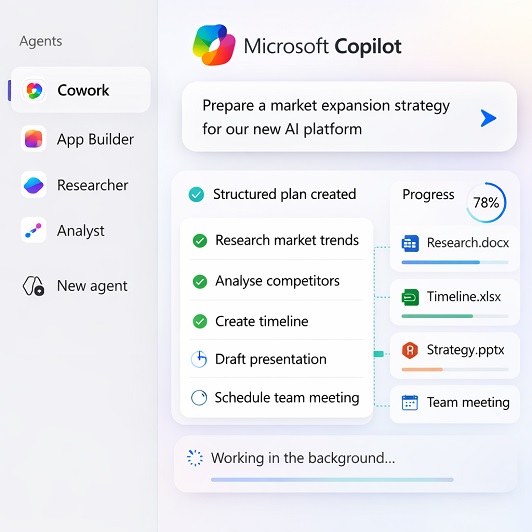
Microsoft has introduced Copilot Cowork, a new artificial intelligence capability designed to move Copilot beyond answering questions and towards completing real tasks across Microsoft 365.

Why Microsoft Wants AI To Do More Than Just Chat

Since launching Copilot in late 2023, Microsoft has steadily expanded the role of AI inside its productivity tools, embedding AI capabilities directly into applications such as Word, Excel, Outlook and Teams.

The company now believes the next stage of workplace AI is turning responses into action. For example, rather than simply suggesting what to do next, Copilot Cowork is designed to carry out tasks across multiple Microsoft 365 applications on behalf of the user.

Microsoft said the goal is to move from answering questions to completing work. The company explained that Copilot is evolving from a tool that drafts responses into one that can help execute tasks across the digital workplace.

How Copilot Cowork Turns Requests Into Workflows

Copilot Cowork allows users to describe the outcome they want and then delegate the task to the AI system.

According to Microsoft, Cowork converts a request into a structured plan and then begins carrying out that work in the background. Users can monitor progress, pause the task or approve suggested actions before they are applied.

The company says the system “turns your request into a plan” and continues executing that plan in the background while allowing users to review each stage of progress.

This approach reflects a broader industry trend toward so called agentic AI systems, which are designed to execute tasks rather than simply generate answers.

The Role Of Work IQ In Understanding Workplace Data

A key element behind Copilot Cowork is a technology Microsoft calls Work IQ.

Work IQ acts as a context layer that connects enterprise data stored across Microsoft 365 applications. This includes emails in Outlook, files in SharePoint and OneDrive, conversations in Teams and documents created in Word, Excel and PowerPoint.

The same technology is also underpinning Microsoft’s new Microsoft 365 E7 bundle, sometimes referred to as “The Frontier Suite”, which combines Microsoft 365 E5 with Copilot and a new automation capability known as Agent 365.

Work IQ links organisational knowledge with AI tools so that Copilot can understand how projects, documents and communications relate to one another before taking action.

Why Microsoft Is Partnering With Anthropic

Another notable aspect of Copilot Cowork is Microsoft’s decision to incorporate technology from multiple AI developers.

The system includes Anthropic’s agentic AI technology and supports several AI models, including those developed by OpenAI and Anthropic. This multi model approach allows Microsoft to select different AI models depending on the task being performed.

Industry analysts say this reflects a broader direction in enterprise AI platforms, where companies combine several AI models rather than relying on a single provider.

Microsoft has already begun rolling out these capabilities as part of the latest wave of Microsoft 365 Copilot updates.

Growing Investment In Copilot

The launch of Copilot Cowork forms part of Microsoft’s wider effort to increase adoption of its AI tools across enterprise customers.

Microsoft said in its 2025 Annual Report that Copilot has reached more than 100 million monthly active users across both consumer and enterprise environments. Chief executive Satya Nadella has also said usage has grown nearly three times year on year.

However, adoption among paid enterprise users remains relatively modest. Industry reports suggest only a small proportion of Microsoft 365 users currently pay for Copilot Chat licences.

The company is therefore expanding the feature set and integrating Copilot more deeply into Microsoft 365 to encourage wider adoption across businesses.

What This Means For Your Business?

For organisations already using Microsoft 365, tools such as Copilot Cowork could change how routine tasks are managed across teams.

AI systems capable of coordinating tasks across email, documents, meetings and research may reduce the time employees spend gathering information or preparing materials for projects.

However, the effectiveness of these tools will depend heavily on how well an organisation manages its internal data and permissions.

As AI systems become capable of carrying out work tasks rather than simply generating responses, businesses may need stronger governance over data access, workflow controls and AI usage policies to ensure these systems operate securely and responsibly.